My best CEO taught me that a lot of product marketing’s value is influence on company decisions.
To that end, she taught me (and demanded) 3 critical thinking behaviors.
Why Critical Thinking Matters to Product Marketers
PMMs influence decisions with lots of people involved, and lots of ambiguity.
Our job is to drive good discussions around those decisions.
Critical thinking makes for richer discussions, and more robust decisions.
Definition
Critical thinking is the organized, skeptical critique of a proposed course of action.
(usually, to make a proposal stronger, not to kill it)
3 Critical Thinking Behaviors
- Naming your assumptions
- Scenario modeling diagrams
- Challenge questions
Naming Your Assumptions
One critical thinking behavior is to name the assumptions being made
(by you, someone else, or the whole group).
When your colleague says
“We should deposition new competitor A the same way we did last year to competitor B”
Name the assumptions:
- Business conditions are the same this year as last year
- Customers will react to our depositioning the same way they did before
- Competitor A will react the same way competitor B did
- etc.
Naming the assumptions aloud will lead to a richer discussion.
Asking if those assumptions are valid will engage people’s brains.
Scenario Modeling Diagrams
You may have been in conversations where people play what-if games,
or where they talk through different stories of what might happen.
These are both examples of scenario modeling.
But to get better discussions, don’t just talk about scenarios, diagram them.
For a proposed course of action, draw branching lines for each potential outcome.
Then, from each initial outcome, draw branching lines with the next potential outcomes.
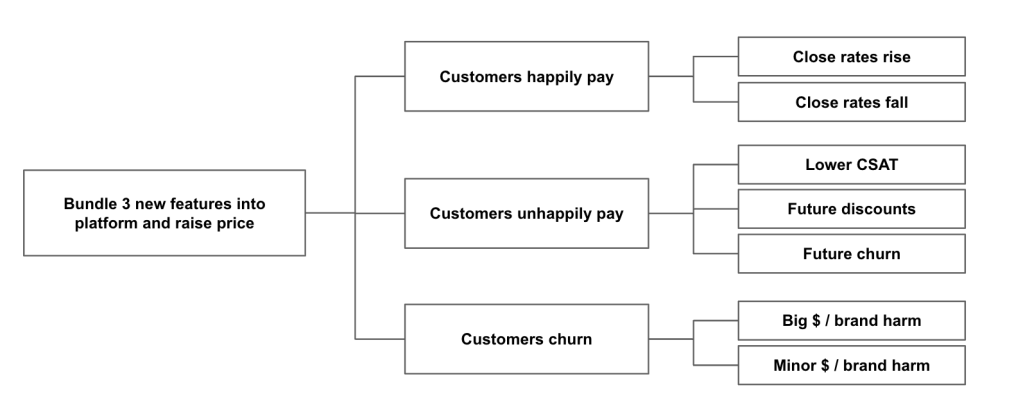
Drawing the diagram will help a group make more robust decisions.
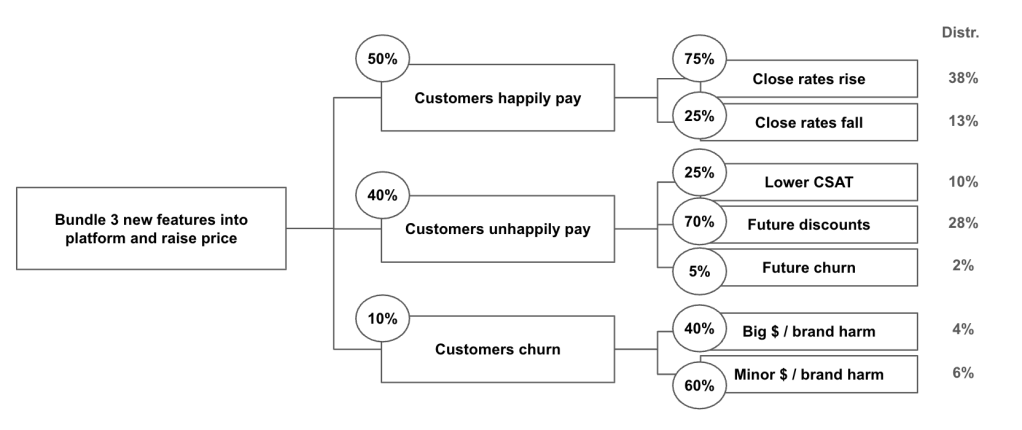
If you want to get fancy, you can even discuss and add in probabilities for each branching..
Challenge Questions
This third critical thinking behavior is to ask questions that challenge the thinking behind into a proposed course of action.
Some examples of challenge questions:
- Which of our assumptions would have to be true for this decision to be correct?
- What stars (uncontrollable variables) would have to align for this to succeed?
- What are the most likely ways this could fail?
Navigating between Intuition and Certainty
The above techniques help drive higher-quality decisions amidst uncertainty.
They embrace our uncertain world
Instead of hoping for certainty
Or fantasizing about perfect intuition.
Some companies paralyze themselves seeking to be certain. Teams that go around for weeks trying to decide messaging for that next big product launch, that new slide deck.
When it’s more successful to quickly do something likely to work.
I also see some on the other end of the spectrum, acting on pure (often executive) intuition. If you have no good competitors, repeatedly throwing spaghetti at the wall might not cost you much. But if you’re in a competitive, dynamic market, it slows down your success.
How to Start
Practice each of these behaviors on a decision or proposal being discussed.
Write assumptions down.
Diagram the scenarios of possible outcomes.
Ask a skeptical question.
It doesn’t have to be all of them, all at once. Just start.
From the front porch in Moss Beach,
Tenders
P.S. There’s a whole decision-making science rabbit hole to go down, if that’s what you’re into.
For onliners, go to the wikipedia pages for analytic hierarchy process, game theory, and operations research.
For those people who like a book, start with “How We Think” by John Dewey. 115 years later, it’s still a good brick to the head.

 Product Marketing Best Practices